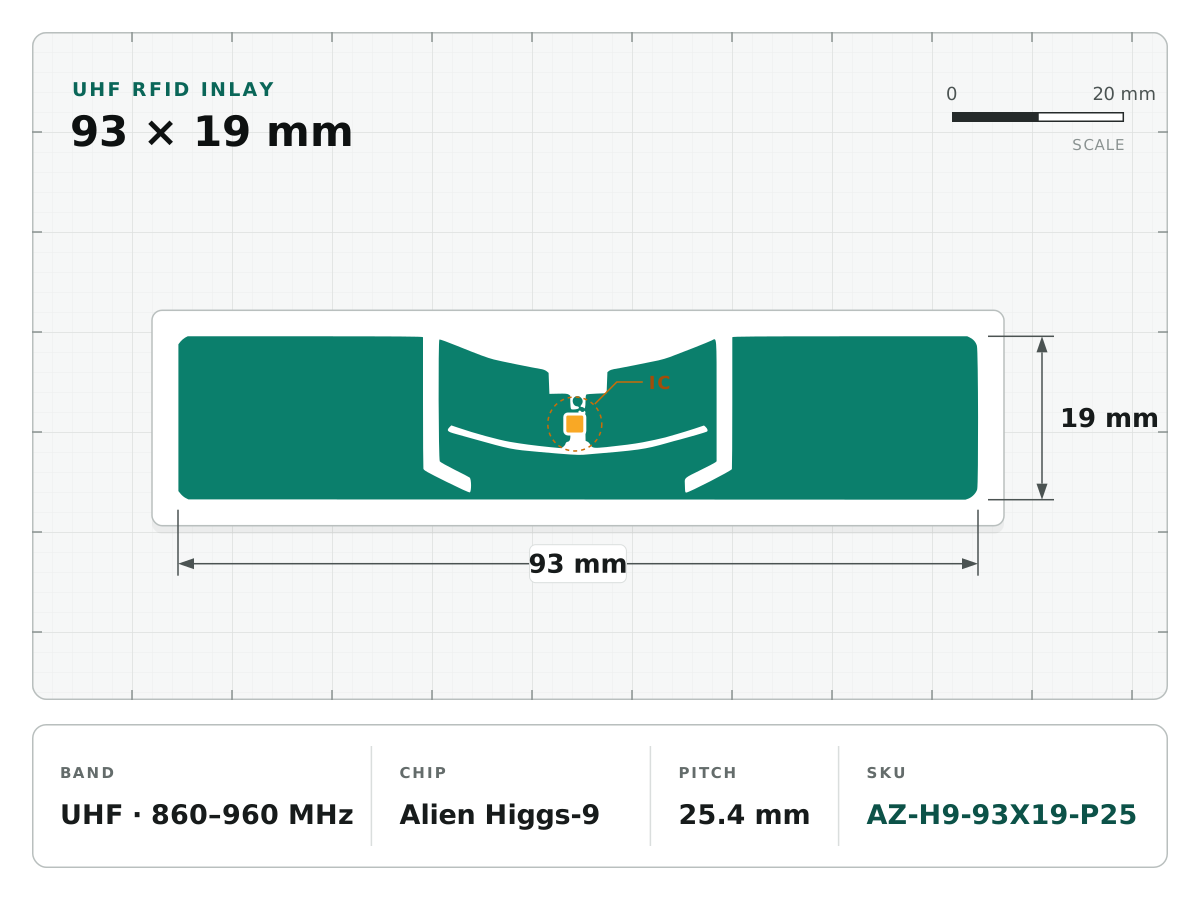
 UHF
AZ-H9-93X19-P25
Higgs-9 UHF RFID Inlay, 93 × 19 mm, 25.4 mm pitch
- Chip
- Alien Higgs-9
- Antenna size
- 93 × 19 mm
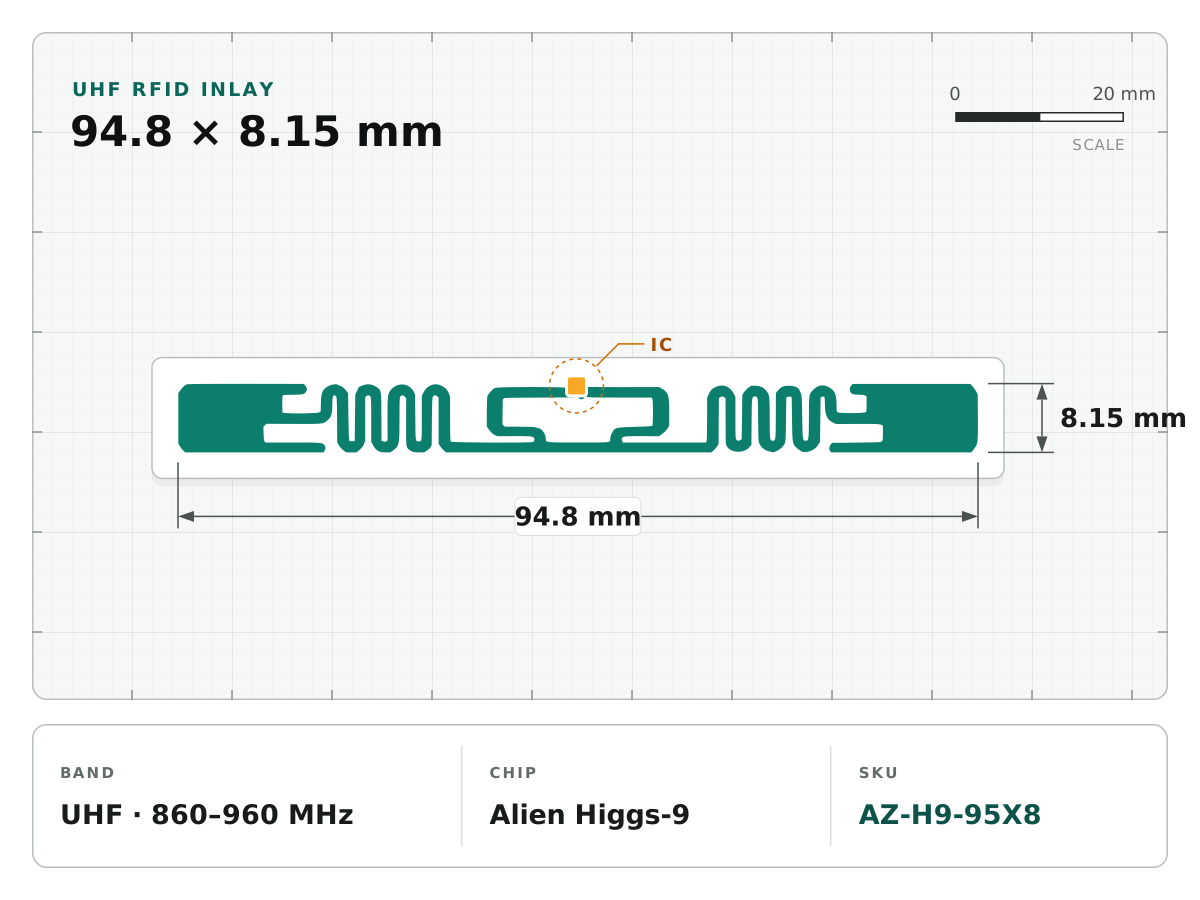
Catalogue illustration. Confirm the actual appearance and supplied construction before selection.
AZ-H9-95X8
Higgs-9 UHF inlay with a 94.8 × 8.15 mm slim dipole antenna, supplied dry, wet or as a finished label.
Validate samples first. Engineer reply within 24 h.
Check suitability for your application
See the sample validation checklist
| SKU | AZ-H9-95X8 |
|---|---|
| Frequency | UHF 860–960 MHz |
| Protocol | EPC Gen2 (ISO/IEC 18000-63), RAIN RFID |
| Chip | Alien Higgs-9 |
| Memory | Configurable EPC up to 496 bits (96-bit nominal) and user memory up to 688 bits; maxima are not guaranteed simultaneously; TID includes a 48-bit unique serial number |
| Chip read sensitivity | −20 dBm (vendor reference) Vendor measurement conditions: 2.15 dBi gain dipole antenna; not finished-tag performance |
| Antenna size | 94.8 × 8.15 mm |
| Format | Inlay (dry / wet / label) |
| Read range | up to 11 m (reference) depends on reader, antenna, power and the tagged material |
| Typical applications | Logistics & supply chain |
PDF · English / 中文
Catalogue selection information; confirm the final construction and performance through drawings and samples.
This UHF RFID inlay combines the Alien Higgs-9 chip with a slim dipole antenna measuring 94.8 × 8.15 mm, a slim strip that fits narrow edges, spines and rims. It is read by EPC Gen2 (ISO/IEC 18000-63) readers across the 860–960 MHz band.
Alien Higgs-9 provides configurable EPC up to 496 bits (96-bit nominal) and user memory up to 688 bits; maxima are not guaranteed simultaneously; TID includes a 48-bit unique serial number. Alien lists read sensitivity of −20 dBm and write sensitivity of −18 dBm as vendor reference values (Vendor measurement conditions: 2.15 dBi gain dipole antenna; not finished-tag performance). Validate the complete tag with samples on the intended item and reader setup. Datasheet highlights: Sentinel Memory (fixes single-bit and flags dual-bit errors), 200,000 write cycles, QuickWrite/BlastWrite and Dynamic Authentication.
Reference read range: up to 11 m (reference). Real-world range depends on the reader, antenna, power and the material the tag is attached to, so treat it as a comparison value and confirm it with samples on your own items.
Buyers typically use this UHF RFID inlay for carton, tote and pallet labels.
The same chip and antenna are available as dry inlay, wet inlay or label; printing, EPC encoding and custom label sizes are quoted on request. Start with samples, then move to volume once the tag passes your tests; volume orders are produced with our ISO 9001-certified production partner and 100% electrically tested inline.
Vendor documents describe the chip, not finished-tag read range.
Confirm catalog dimensions against the final tag construction. Reference read ranges require sample testing on your item with your reader setup.
Confirm the construction and encoding during sampling, then quote the configuration you validated.
Chip and antenna on a PET carrier without adhesive, for your own converting, hang tags or lamination.
The same inlay with pressure-sensitive adhesive on a liner, applied like a sticker.
Paper or synthetic face stock over the inlay, blank or printed, ready for RFID printers.
Other label sizes, face stocks, adhesives, printing, encoding and roll formats on request.
Agree the actual use conditions and pass criteria before selecting samples. The catalogue supports shortlisting; confirm finished-tag performance and delivery configuration in writing and through sample validation.
Record the deployment region, reader, antenna, power, item material and tag position. Test realistic density, orientation and movement; define which items must be read and which must remain excluded.
Record missed and unintended reads by unique identity. Read back the EPC against source data and printed IDs. Test the final roll on the specified printing and encoding equipment, and assess adhesion and mounting separately.
Record the SKU, sample revision, lot, device settings, results and approver. Confirm final dimensions, materials, printing, encoding, quantity and delivery requirements, and agree which configuration changes require another trial.
Use the test record to save actual conditions and results. English and Chinese worksheets are provided; the agreed reviewer determines acceptance.
Download test recordShare surface, read distance, chip preference and volume. We shortlist tags that fit.
Receive sample tags of the shortlisted designs to try in your own setup.
Test on your items, readers and printers. We adjust chip, size or format if needed.
Volume production with 100% inline electrical test, then export shipping.
Understand dry inlays, adhesive wet inlays and converted labels. Specify the antenna, finished dimensions and roll format so your RFID order is usable.
Compare UHF chip memory, reader features and lifecycle support. Use official datasheets to shortlist chips, then test the complete inlay on your items.
UHF AZ-H9-93X19-P25
 UHF
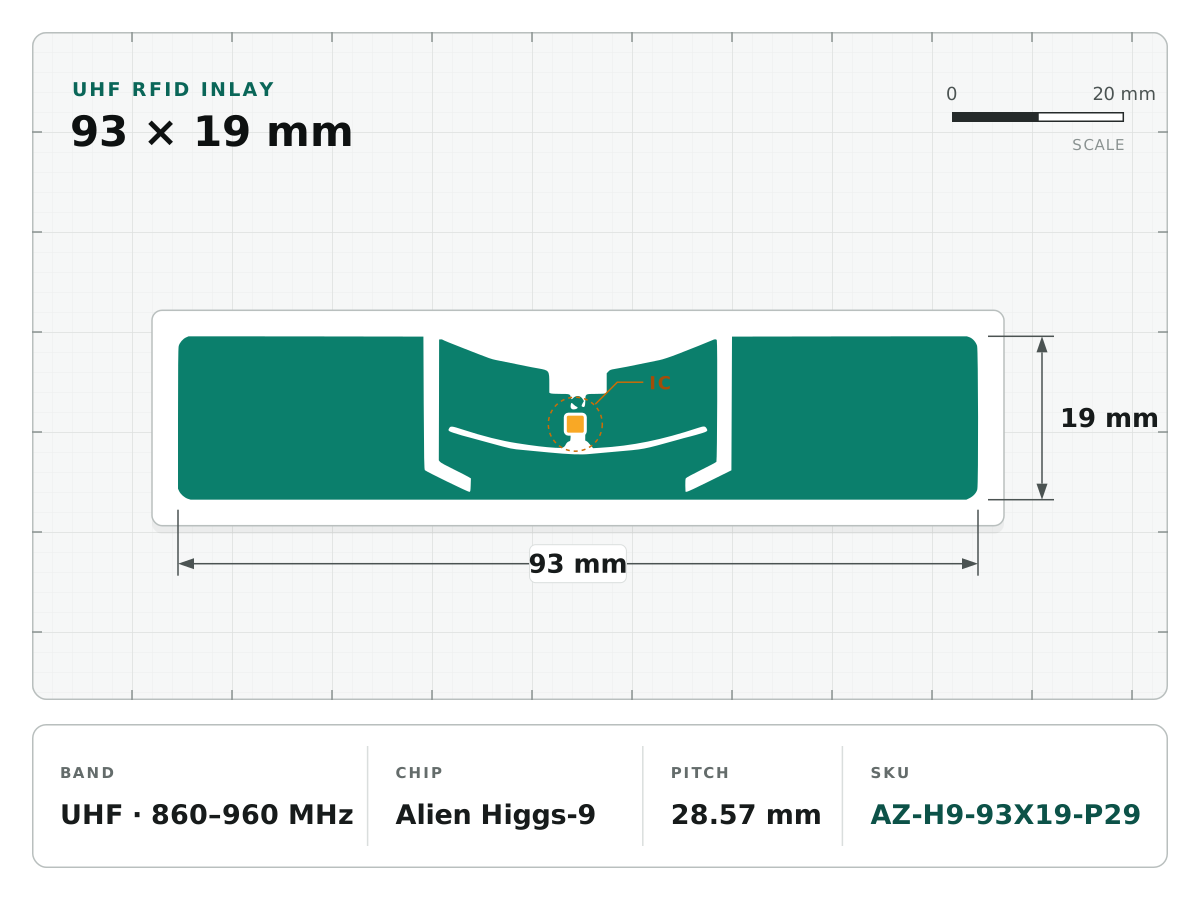
AZ-H9-93X19-P29
 UHF
 UHF
Talk to an RFID engineer
Send the surface, read distance and volume. An engineer replies within 24 hours with a recommendation and a sample plan.
Email us: sales@antenza.com