 UHF
Converter procurement
RFID inlays for label converters
Define the supply format and converting conditions before choosing an antenna and chip. Trial a sample roll through insertion, lamination, die-cutting, printing and encoding, then validate the finished label in your customer’s application.
Choose the supply format for your process
Dry inlays, wet inlays and finished labels leave different steps to your line. Agree the final construction and equipment before confirming the format offered for a candidate design.
| Dry inlay | Chip and antenna on a carrier, without pressure-sensitive adhesive. For a process that adds face stock and adhesive, confirm the carrier, registration method and die-cut clearance. |
|---|---|
| Wet inlay | Inlay with pressure-sensitive adhesive and a release liner, for insertion workflows. Confirm adhesive, liner and outline; a wet inlay is not automatically a printable finished label. |
| Finished RFID label | Specify the face stock, inlay, adhesive and liner construction. Agree finished dimensions, print surface and rolls; validate printing and encoding on the named equipment. |
Supply-format references from Avery Dennison
Quote against one agreed specification
Send contact details, target markets and any existing drawings; mark unknowns as “to confirm”. Sample quantity, any cost, volume terms and delivery arrangements are confirmed in the written quote.
| Item & final construction | Use case, tagged material, available space, label outline, face stock, adhesive, liner and environment. Separate antenna dimensions from finished dimensions. |
|---|---|
| Converting & print equipment | Equipment models, insertion or lamination method, die-cut position, intended line speed, printer and encoder positions. Identify process constraints. |
| Roll drawing | Web width, longitudinal pitch, lanes and transverse spacing, chip position, registration marks, core, maximum diameter, winding, splice requirements and quantity per roll. |
| Region, band & chip | Deployment countries, readers, permitted frequency and power, candidate chip, EPC/user memory needs. Supply original industry or customer requirements where applicable. |
| Data & encoding duties | Who supplies identifiers and who encodes? Agree EPC/barcode mapping, uniqueness, read-back checks, locking rules, and responsibility for marking and rejecting failed units. |
| Quantity & delivery | Sample-roll quantity, pilot and expected volume, target date, destination and packing. Price, MOQ and timing follow the approved quotation. |
| Acceptance & traceability | Test items and conditions, expected/read/unintended-read counts, print/encoding/adhesion criteria, defect handling and lot records. Agree these in writing before trials. |
Start the review with three catalogue designs
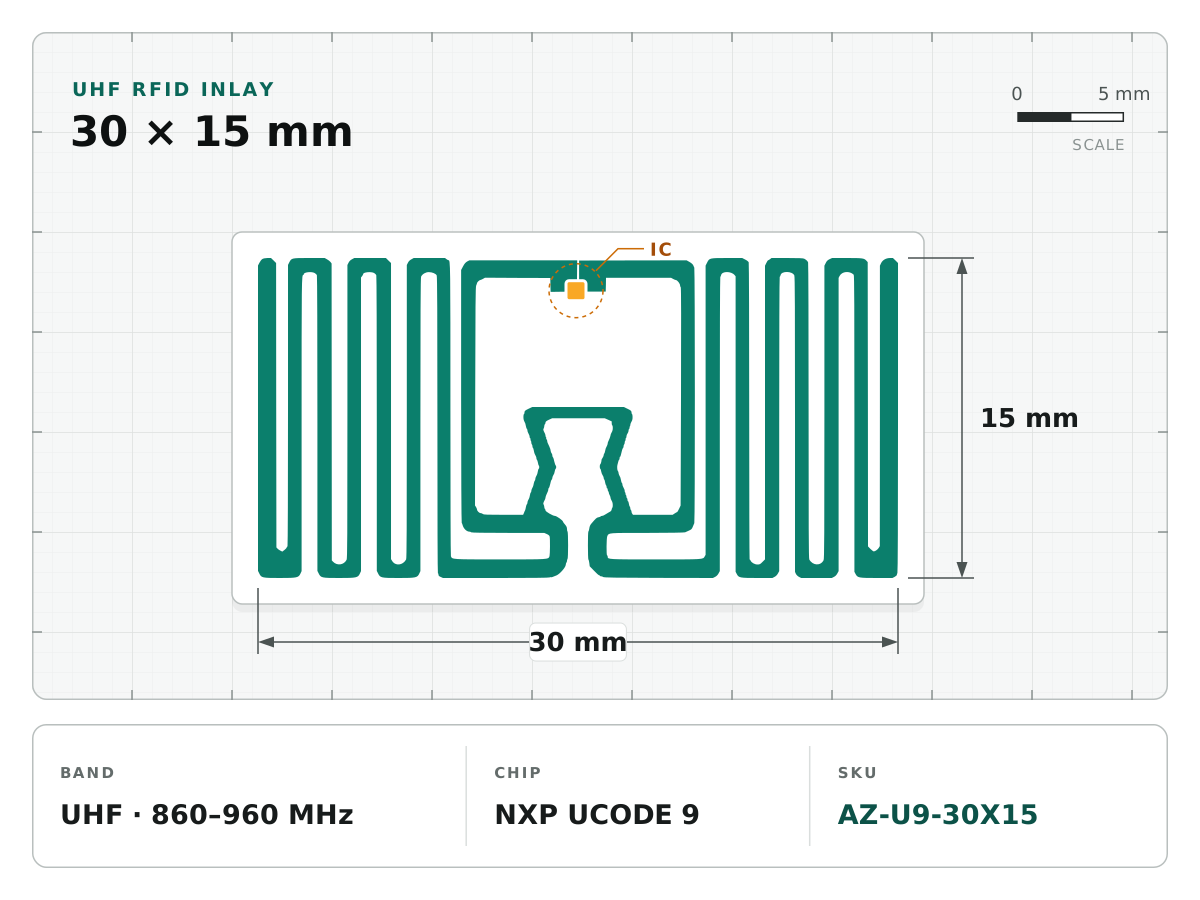
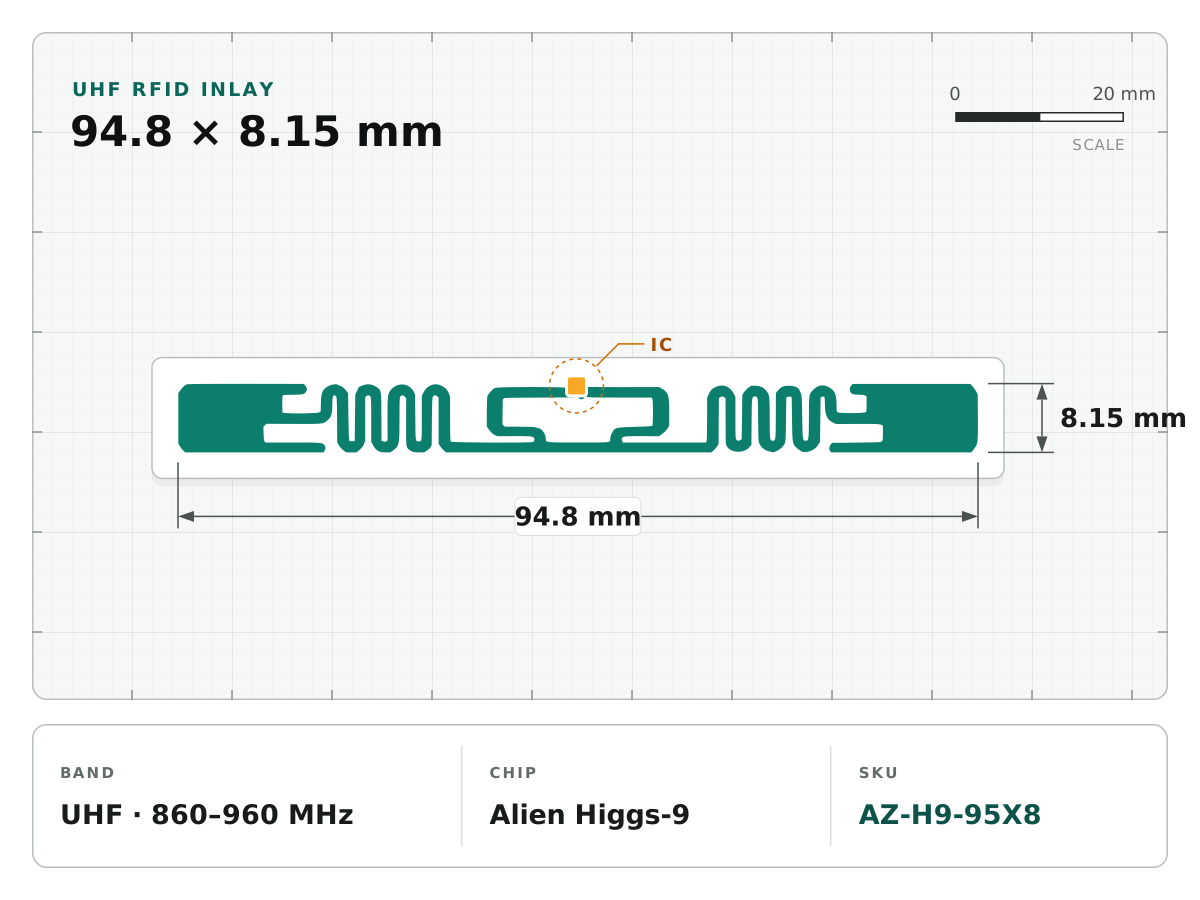
These are selection candidates, without a claim of stock, certification or printer compatibility. Card dimensions describe the antenna; dry/wet format, finished label size, rolls and converted performance need drawing and sample approval.
UHF 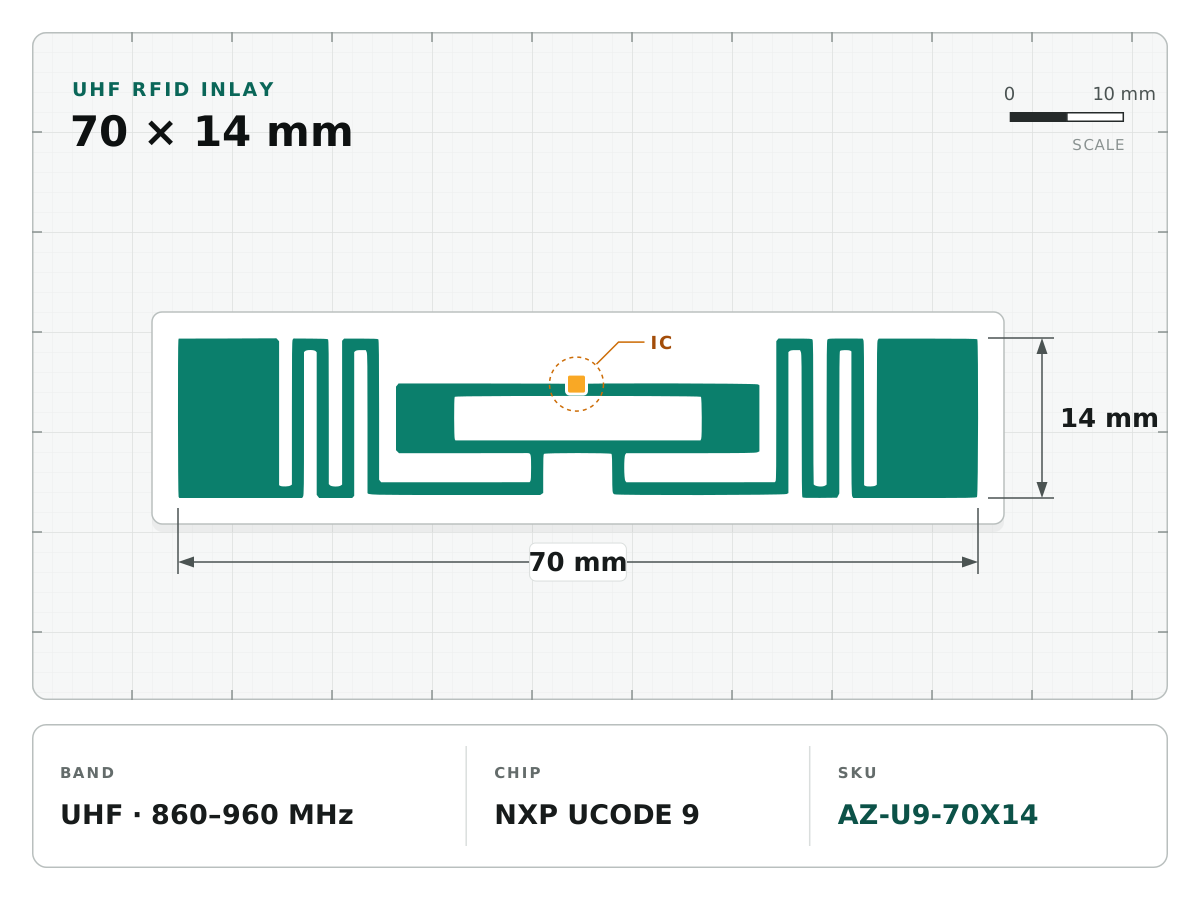 UHF
 UHF
Catalogue selection information; confirm the final construction and performance through drawings and samples.
AZ-U9-30X15 Catalogue specification summary
Confirm supply information AZ-U9-30X15 PDF · English / 中文
AZ-U9-70X14 Catalogue specification summary
Confirm supply information AZ-U9-70X14 PDF · English / 中文
AZ-H9-95X8 Catalogue specification summary
Confirm supply information AZ-H9-95X8 PDF · English / 中文
Evaluate the supplier and the converted label
-
Check specifications and evidence
Ask the supplier to confirm drawing revision, actual chip, material stack, lot traceability and defect handling. For customer-required certificates or test reports, check the exact design and scope.
-
Trial the roll and test finished labels
Record reads, unintended reads, encoding, print and adhesion before and after converting, with equipment, line speed and lot. Validate on real items under the customer’s read conditions; read completeness alone does not establish acceptance.
-
Approve the volume reference in writing
Use the validated drawing, sample, rolls, data duties and acceptance criteria as the order reference. Confirm quote and delivery terms, and agree review of chip, material or process changes.
Procurement and sample test tools
Use editable worksheets to prepare specifications and test results for selection, quotation and sample approval before volume orders.
RFID RFQ specification sheet
Record the application, materials, dimensions, equipment, rolls, printing, encoding and purchasing requirements. Leave undecided specifications blank.
Excel (.xlsx) · English / 中文
Sample test record
Document the actual equipment and test conditions, read counts, unintended reads, and print and encoding checks. Record acceptance separately.
Excel (.xlsx) · English / 中文
Each Excel workbook contains English and Chinese worksheets. Complete one worksheet and keep the file for later comparisons.
Email completed worksheets to our sales team, or paste the key requirements into the inquiry form.
sales@antenza.comConverter purchasing questions
Is the catalogue antenna size the finished label size?
No. Face stock, liner, die-cut clearance and insertion position affect finished and roll dimensions. Supply the final label drawing rather than setting equipment from the dimensions in a SKU.
Can dry and wet inlays use the same line settings?
Confirm each construction separately. Supply format, adhesive, liner, chip position and rolls affect processing and inspection. Trial the intended construction; a wet inlay also needs a confirmed print surface and does not imply printer compatibility.
Who handles EPC encoding and failed units?
Assign duties in the quote and order: identifier source, encoder, barcode mapping, read-back/uniqueness checks, locking, and marking and rejecting failed units. Acceptance records should identify the actual lot and test conditions.
Selection guides
-
Dry Inlay, Wet Inlay or RFID Label: What Are You Buying?
Understand dry inlays, adhesive wet inlays and converted labels. Specify the antenna, finished dimensions and roll format so your RFID order is usable.
-
How to Test RFID Tags Before Approving a Bulk Order
Plan an RFID sample test with real items, controlled reader settings and acceptance criteria. Check RF behavior, encoding, adhesion and repeatability.
-
RFID Label Printer Compatibility: Qualify the Whole Roll
Check inlay placement, label pitch, media thickness and encoding settings. Qualify a sample roll on your exact RFID printer before placing a bulk order.
Talk to an RFID engineer
Bring your drawing and converting conditions
Send contact details, target markets and any existing drawings; mark unknowns as “to confirm”. Sample quantity, any cost, volume terms and delivery arrangements are confirmed in the written quote.
Email us: sales@antenza.com